
BIKAI deuterium lamp (Substitute deuterium lamp)is a cost-effective alternative to the original deuterium lamps of mainstream HPLC instruments such as Shimadzu, Agilent, Waters, etc. Its adaptability and stability are more advantageous than those of the original manufacturers, and it is suitable for budget control and routine detection scenarios.
Core adaptation model and parameters
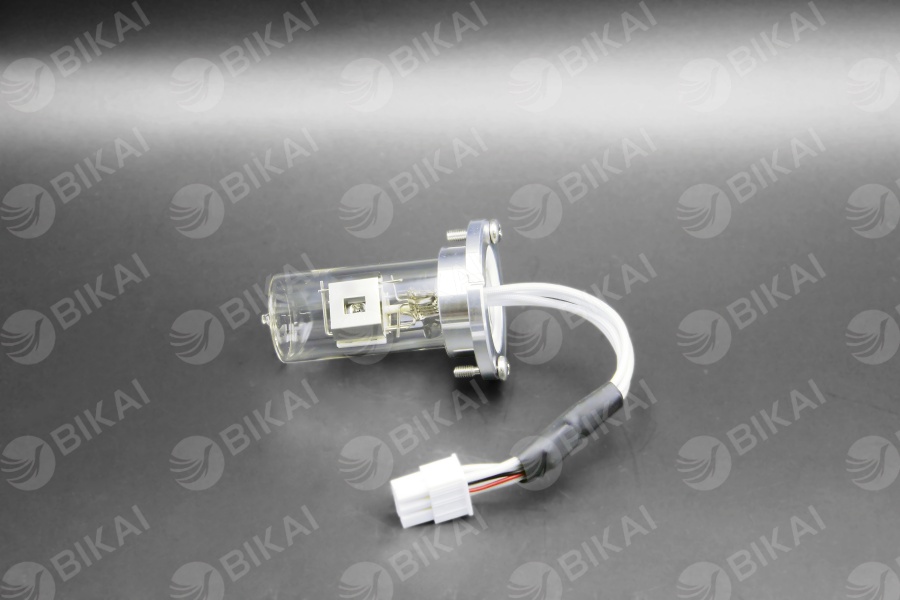
BIKAI model adapted to Shimadzu SPD-10A/10AV/10VP and LC-10A series is BK82020281, corresponding to Shimadzu original part number 228-34016-02, with a spectral range of 190-400 nm, a service life of not less than 2,000 hours and plug-and-play support.
For Shimadzu SPD-M30A detector, there is a special BIKAI model corresponding to Hamamatsu L12269, which matches the original part number of 228-54515, and its service life follows the standard of 2000 hours or one year after purchase, whichever comes first.
Adapting to Agilent’s BIKAI model can correspond to the original part number of 2140-0820, and can be compatible with Agilent’s 1100/1200/1260 series VWD and DAD detectors; The model adapted to Waters matches the original number of 2487/2489 and can be directly used in Waters 2487/2489 and 2695 systems.
Alternative advantages and risk warning
Performance and compatibility
The spectral range covers 190-400 nm, which is completely consistent with the original factory, and can meet the needs of routine ultraviolet detection such as drug detection and environmental pollutant screening. The mechanical interface and electrical specifications are accurately matched with the original lamp, and the installation process does not require any modification of the instrument, which is suitable for the mainstream detector types such as SPD, VWD and DAD. Baseline stability and light intensity attenuation rate are at the same level as those of the original lamp, which can fully support routine content determination and impurity screening.
Cost and life span
The price is usually only 60%-80% of the original lamp. Long-term bulk purchase and use can significantly reduce the cost of laboratory consumables. BIKAI deuterium lamps purchased through regular channels have a warranty life of not less than 2,000 hours, which is the same as the original standard. Some high-end models also support the automatic reset function of RFID lamps without manual operation and calibration.
Risk and avoidance
BIKAI deuterium lamps circulating through unauthorized channels may be refurbished or counterfeit, and the use of such products is prone to problems such as baseline drift, insufficient light intensity and greatly shortened service life, so it is necessary to purchase them through officially authorized agents or qualified suppliers. After replacing the deuterium lamp, it is necessary to reset the deuterium lamp service time timer according to the requirements of the instrument operation manual, and carry out wavelength accuracy calibration and baseline noise test to ensure the reliability of the test data.
General process of replacement and maintenance
First, turn off the power supply of the instrument and power off. After the detector lamp room is completely cooled, wear anti-static gloves to open the cover plate of the lamp room, carefully remove the old deuterium lamp, and be careful not to directly touch the surface of the Shi Ying window of the lamp body to prevent stains from affecting the light transmittance.
Align the new BIKAI deuterium lamp with the socket, make sure that the pins are completely matched with the socket, and then tighten the fixing screws gently, paying attention to distinguish the screw positions, and do not touch or loosen the optical components in the lamp room.
Connect the power cord of deuterium lamp, cover and lock the lamp chamber cover, and let the instrument warm up for 30 minutes after power on, until the light source output is stable.
Enter the maintenance menu interface of the instrument, complete the reset operation of deuterium lamp service time, then use standard materials (such as methanol solution of naphthalene) to calibrate the wavelength accuracy, and at the same time detect the baseline noise and drift, and then carry out sample detection after confirming that all indicators meet the standards.